AI Hallucinations Prompt D.C. Court of Appeals to Review Sanctions Rules
Human-Written Summary: In a footnote to an Order issued today, the D.C. Court of Appeals noted that it is seeking analysis from the Rules Committee regarding the scope of the Court's sanctions authority in cases involving hallucinated case citations.
One might be forgiven for assuming that it was the pro se party being accused of filing AI hallucinated citations while beginning to read the D.C. Court of Appeals Order in Douglas v. Deutsche Bank. When I see that "pro se" and "hallucination" appear in the same opinion, even I can't help myself from jumping to the conclusion. As lawyers, we mostly assume that we are better than the lowly uninitiated member of the public having spent years of our lives (and however many hundreds of thousands in tuition) studying and practicing the subject of The Law (TM). Certainly the bar, the exclusively gatekept club so obviously infallible that it admitted us as members could not have made a mistake and admitted alongside us, so many charlatans? Certainly the lowly public must far outnumber our enlightened class in this error?
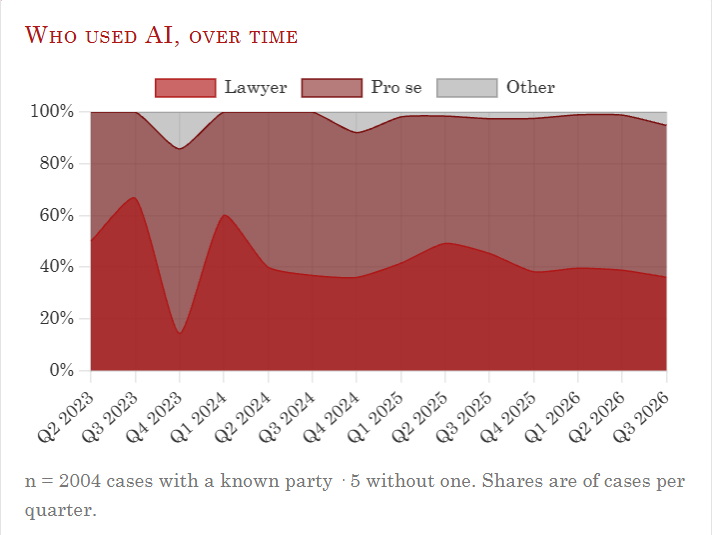
Of course, we lawyers are also often incorrect, as according to data collected by professor Damien Charlotin in his AI Hallucination Cases Database, lawyers and pro se litigants are not nearly as far apart when it comes to filing hallucinations as one might first guess. Pro se litigants have the clear lead, with 1156 cases documented in the database, while lawyers are sitting at a respectable 799 as of the date of writing. And in an order issued today, the pro se side gets to watch the gap narrow by one more. (As of the time of writing, this case was not included in the database).
Earlier today the D.C. Court of Appeals issued a per curiam order in Douglas v. Deutsche Bank, No. 24-cv-1099, 2026 WL 2603056. The case involves an appeal from a D.C. Superior Court order granting judgement on the pleadings to Deutsche Bank. Mr. Douglas brought the appeal pro se while Deutsche Bank was represented by the firm McCabe, Weisberg & Conway (Apparently re-branded to just "McCabe" now). The details of the underlying case are immaterial to the issues addressed in the Order, as explained by the Court:
"Both parties filed briefs and this appeal was submitted to the court for decision without argument on March 11, 2026. While reviewing appellee’s brief, the court discovered that it contained multiple citations to cases that the court was unable to locate or confirm as legitimate. On June 22, we issued an order requiring appellee to show cause “why the court should not strike its brief for citing nonexistent cases that are possibly the product of artificial intelligence (AI) hallucinations.” The next day, one of appellee’s attorneys at the firm, Loishirl W. Hall, filed a response in her own capacity. Ms. Hall confirmed that four of the brief’s cited authorities did not exist. She acknowledged that these citations were “not legitimate legal authority” and “should not have appeared in a brief filed with this Court.”
"Ms. Hall explained that she had “used Google’s generative artificial intelligence search tool to assist in locating case authority” and did not verify the existence or accuracy of those citations before filing the brief. She recognized that she had a duty to verify the accuracy of every authority submitted to this court and apologized for her failure to do so. As part of this mea culpa, Ms. Hall assured the court that she had taken the remedial measure of verifying that the remaining citations in the brief were legitimate authority and pledged that, going forward (presumably in her representation of other clients), she would not rely on any AI tool “for legal research without confirming each authority” or file anything that includes citations she has not independently verified. Ms. Hall represented that she 'deeply regrets this error and the burden it has placed on the [c]ourt and all parties.'"
Id. at 1-2. (all page cites are to the PDF page number in the linked version above, unless I goofed). The opinion further spells out how Ms. Hall's firm threw her onto a race-track in front of a fleet of busses, and notes that Ms. Hall was no longer practicing at the firm.
The majority's discussion and analysis follows the trend that appears most prevalent when courts address hallucinations and other AI product-related misconduct of assuring that the court is not opposed to the use of AI. The majority makes clear that "Our intent is not to discourage attorneys from using AI—indeed, we have reached a point where attorneys eschew at least an understanding, if not use, of AI at their own peril—but to emphasize the importance of doing so discerningly and responsibly. To put a finer point on it, “the use of artificial intelligence must be accompanied by the application of actual intelligence in its execution.” Id. at 4 (quoting Amarsingh v. Frontier Airlines, Inc., No. 24-1391, 2026 WL 352016 (11th Cir. Feb. 9, 2026)).
I do not see any reason for this lack of intent to discourage attorneys from using AI, encourage away I say. But the Court does lay the groundwork for taking stronger action at least against hallucinations in the future.
First, the court devotes three paragraphs to explaining that the risks of using AI chatbots in the practice of law are at this point well known. The Court cites to both case law and publicly available reporting and guidance to make the point clear that at least within D.C. "attorneys can no longer credibly claim ignorance of [AI's] pitfalls, including its propensity to hallucinate legal authority." Douglas, 2026 WL 2603056 at 3.
It is not uncommon for the AI-assisted party, facing scrutiny from the court, to make such a claim of ignorance that chatbots can and do produce hallucinations. The poor naive soul merely placed too much trust in their new friend version 5.2. And I am not unsympathetic to some of these claims. (repeat hallucination filers tend to not get the benefit of the doubt from me see e.g. Cole v. Hobby Town 4:25-cv-04217, 2026 WL 2593255). My sympathy comes from knowing how these tools are marketed to lawyers. At all law firms, big and small, the pressure is there from every side to use LLM products in your practice. They are constantly being talked up as "the future," able to make any lawyer instantly better, smarter, hotter, and with 30% more free time. But the Court's observation is correct that only a lawyer with their head truly in the sand could credibly claim to have no knowledge of hallucinations.
The majority then discusses an attorney's obligation to use AI responsibly (if at all), making the point that while AI products are new, "the ethical duties they implicate are not: attorneys have always been responsible for 'ensur[ing] that the legal propositions and authority they rely on are trustworthy.'" Douglas, 2026 WL 2603056 at 4 (quoting ByoPlanet v. Johansson, 792 F. Supp. 3d 1341, 1347 (S.D. Fla. 2025). In describing the harms inflicted by hallucinations, the Court sates:
The harm inflicted by the submission of hallucinated authority cannot be overstated. We expect attorneys, as officers of the court, to submit briefing that give[s] us the best view of what the law is, and how that law supports their clients; indeed, we rely on that briefing to help us reach the correct conclusion. A brief containing fake citations masquerades as useful advocacy, but it misdirects the court, burns time and resources, and sows confusion while the court gets to the bottom of the matter. By then the damage is done: the court is left without real guidance from one side of the adversarial equation and the client is left without a credible advocate.
At bottom, our system of justice depends on advocates’ candor to the court. Failures like those here undermine the administration of justice. Had any of the firm’s attorneys reviewed the brief prior to filing, they would have discovered the errors. Their failure to do so is highly concerning.
Id. at 5 (internal citations & quotation marks omitted)
However, the court declined to impose sanctions on counsel directly, as the rules of the D.C. Court of Appeals do not permit the Court to impose sanctions under its inherent authority absent a showing that the conduct in question was "in bad faith, vexatiously, wantonly, or for oppressive reasons." The D.C. Court of Appeals currently lacks an applicable version of Federal Rule 11 in its own rules that bars the making of unwarranted factual or legal claims.
At the end of the day, the Court struck the brief containing the AI hallucinations and referred the matter to the office of disciplinary counsel for further proceedings. The Court's refusal to give the benefit of the doubt, despite the hallucination filer's full admission, apology, (apparent firing or resignation from her firm) and all the other circumstances demonstrates how some courts are running out of patience for attorneys who file hallucinations.
Courts, like every part of the legal community, are seeing more and more AI every day, for good or for ill. (mostly ill). The amount of hallucinations being filed necessitates dozens of court orders and opinions every week, taking up valuable court time and resources. Any obsessive reviewer of opinions involving hallucinations like myself can see that sometimes (and seemingly increasingly as days go on) Courts are showing that they, like many of us, are fed up with hallucinations, or AI use in general.
The almost universal experience of every attorney practicing right now is one of an unstoppable deluge of slop, pouring from inboxes, toolbars and every colleague you've ever tried to escape talking to. Spam filters are being crushed as we speak with emails about how you can now use a chatbot everywhere you've never needed or wanted to use a chatbot. Adrian from the technology department wants to tell you about how you know have access to products with fun people-sounding names like, Harvey, Legora, and DefinitelyNotStealingYourData.AI, while You'd just like to know which system you should be saving large PDFs to this week. When you decide to check how that friend who went in-house is doing, you get to see your LinkedIn poster high-school friend just wrote their 9th straight post about AI being new crypto without understanding how correct they are.
Within law firms, many that have bought into the AI craze have "ambassadors" of the legal AI product(s) to encourage more use around the firm. I know several of these myself, who are generally normal, competent attorneys. But several of them are on the older end of the age-spectrum, and not exactly from the generation that was born with an iPhone in hand. You will be shocked to learn that there isn't a corresponding crew of haters wandering the halls looking to beat up Ivy Leaguers and tell everyone about the 5 new opinions issued relating to AI hallucinations that day. Yet many of us wish there was exactly that. A counter-force to the hype. A loud verbal hater who yells from the rooftops all the complaints we have longed to hear others echo.
Senior Judge Glickman, a Bill Clinton Appointee, yelled back loud and clear in his concurrence to the majority opinion. Judge Glickman wrote separately to discuss (1) the scope and limits of the court’s authority to sanction attorneys; (2) the varying responsibility of attorneys whose names appear on a brief for another signatory’s inclusion in the brief of AI-hallucinated citations; and (3) the concern beyond the risk of fake citations when attorneys rely on generative artificial intelligence to draft briefs.
The majority opinion notes the concurrence's discussion of the Court's sanctions authority in referring the issue to the Rules Committee, and Judge Glickman specifically argues that the authority should be expanded to allow for sanctions as here where it cannot be shown that the filer acted in bad faith, vexatiously, wantonly, or for oppressive purposes. In other words the Court (if it follows Judge Glickman's suggestion) appears to be aiming to enact a version of F.R.C.P. 11 within the Court's own rules to allow for sanctions for the making of unwarranted factual or legal claims within filings without a showing of bad faith. While still discretionary, the rule would allow courts to sanction attorneys directly for hallucinations, and avoid harming parties who may be represented by unscrupulous counsel.
The majority and concurrence agree that every attorney who signs a brief containing AI hallucinations, has some responsibility for it but the concurrence elaborates on what may be required of signatories as individual attorneys and as a firm by proposing practices. The concurrence endorses an individualized approach to assigning primary responsibility based on who actually drafted and had responsibility for checking the section(s) that contained hallucinations.
But the concurrence finishes with a spirited diatribe against the use of AI products within the profession at all. Titling the section "The Greater Concern" Judge Glickman lays out his position. One which I wholeheartedly endorse, and recommend reading in full.
"Bad as AI-fabricated citations are, we should recognize that they are only the tip of a perilous iceberg. That iceberg is the use of artificial intelligence not only to research the law but also to draft a brief. This temptation is the more serious evil, and not just because of hallucinated citations. To begin with, the fallibility of AI as a tool for lawyers is by no means limited to invalid citations. Notably, as the Ninth Circuit explained in Malkeet Lnu, generative AI “is prone to make, at least in its current stage of advancement,” two types of mistakes—not only fabrications, but also what the court described as “inaccuracies”:
Fabrications are instances in which the generative AI tool provides cases or quotations that do not exist at all. Inaccuracies are more subtle. The generative AI tool might cite to real authorities but provide an answer that is legally or factually inaccurate or not supported by the citation.
Fabrications are the most notorious hallucinations, but inaccuracies may prove more dangerous to our profession in the long run. Inaccuracies are more likely to go unnoticed by attorneys and judges because they are not always susceptible to facial checks. Rather, identifying these misunderstandings often requires close analysis of cited sources. With close analysis, some inaccuracies might be clear—for instance, claiming that a case expressly stands for a proposition about a certain topic when the case does not discuss that topic at all. Others may be difficult to distinguish from poor legal reasoning.
And inaccuracies are common, even in newer generation models that produce fewer fabrications. Including inaccuracies, legal-specific generative AI tools from Westlaw and Lexis hallucinated 17% and 33% of answers, respectively, to a representative set of queries run in 2024. The most common error modes of the latest generation tools include misunderstanding holdings, failing to distinguish between legal actors (e.g., presenting a rejected party argument as the holding of the court), and failing to respect the hierarchy of authorities. In other words, the sort of errors that we might expect a first semester law student to make, but certainly not licensed attorneys appearing before this court.
Even worse, perhaps, is the fact that relying on AI to do the “thinking” necessary to draft and refine a brief—even what is intended to be only a first draft— is an abdication of the lawyer’s duty and a breach of the client’s (and the public’s) trust. Lawyers are entrusted with the responsibility to use their own unique human experience, insight, and creativity in employing their skills, learning, and judgment to write, advocate and persuade; and, in doing such writing, to choose among options and alternatives; to select and comprehend precedents and authorities; to make moral and ethical decisions; to evaluate which claims and contentions to pursue and which not; and so forth. AI cannot duplicate that multifarious exercise of human judgment and ingenuity in the “thinking” enterprise.
We do not know in this case whether Ms. Hall relied on Google not only to find case citations, but to draft her brief. I hope she did not do so, and that lawyers will refrain from such conduct."
Id at 16-18 (Big chunky quote within a quote that I'm not going to bother to properly cite, because I don't Bluebook)
It is unlikely that AI will disappear, as much as I may wish that to be the case. In the absence of an absolute ban or other sufficient action, we will have to hope that the Courts will take some substantial action to stamp out the flood out hallucinated filings. As Judge Murphy of the District of Massachussets recently observed,
"[P]articularly as artificial intelligence makes the production of language cheaper and faster - undoubtedly a boon to those that have historically been unable to afford garrulous counsel - it will become increasingly incumbent upon courts to insist that parties respect our limited bandwidths, lest we all drown in a sea of slop."
Kelleher v. Town of Brookfield, No. 25-40071 2026 WL 91849 at *1 n.3 (D. Mass. Jam. 5, 2026)
DISCLAIMER: I am an attorney licensed in the District of Columbia, but nothing on this website creates any attorney-client relationship or is provided for the purposes of nor does it constitute legal advice. The information herein is provided solely as commentary, and for its educational or informational value.